Publications
publications by categories in reversed chronological order. generated by jekyll-scholar.
-
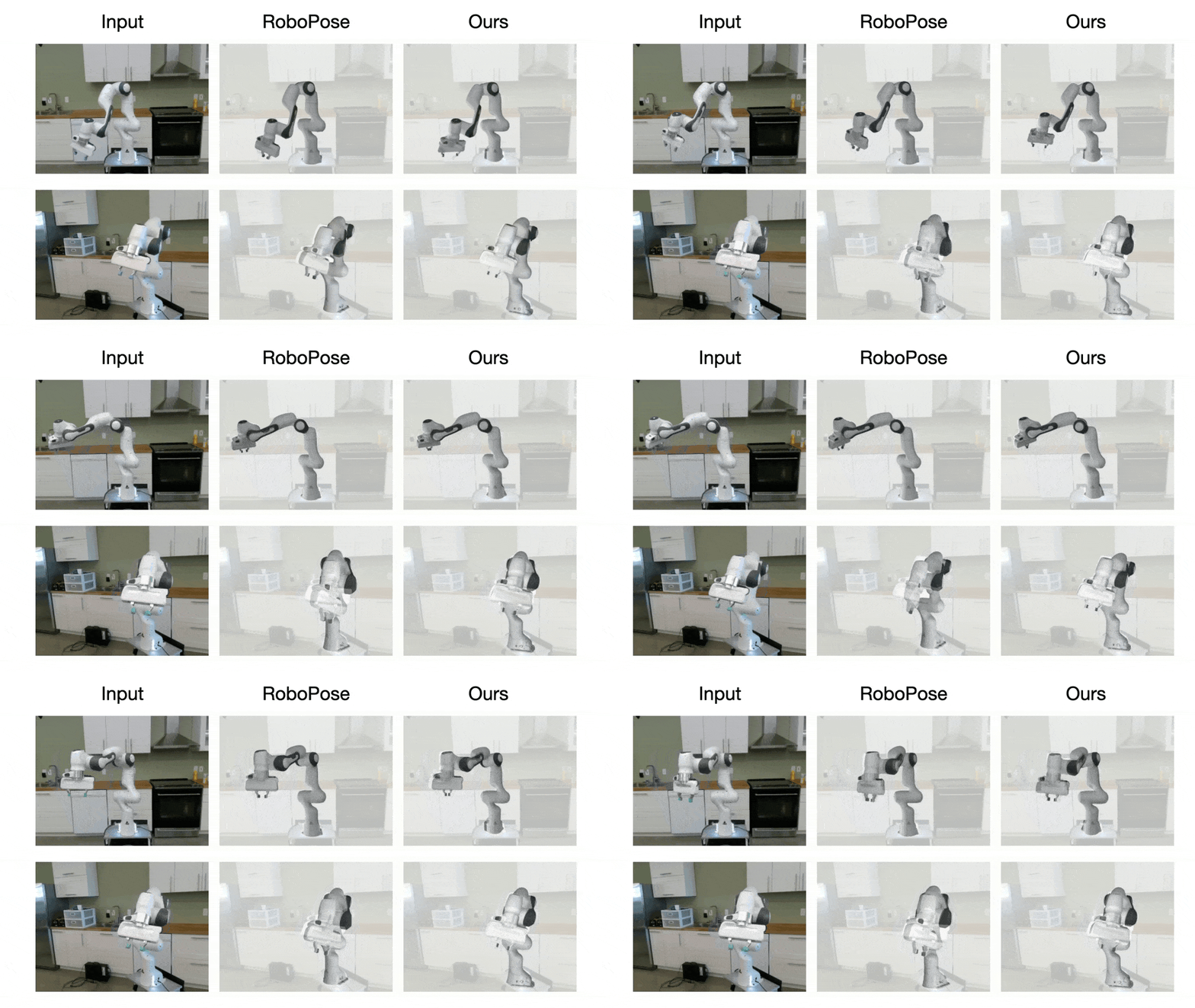 Real-time Holistic Robot Pose Estimation with Unknown StatesShikun Ban, Juling Fan, Xiaoxuan Ma, Wentao Zhu, Yu Qiao, and Yizhou WangIn European Conference on Computer Vision (ECCV), 2024
Estimating robot pose from RGB images is a crucial problem in computer vision and robotics. While previous methods have achieved promising performance, most of them presume full knowledge of robot internal states, e.g. ground-truth robot joint angles. However, this assumption is not always valid in practical situations. In real-world applications such as multi-robot collaboration or human-robot interaction, the robot joint states might not be shared or could be unreliable. On the other hand, existing approaches that estimate robot pose without joint state priors suffer from heavy computation burdens and thus cannot support real-time applications. This work introduces an efficient framework for real-time robot pose estimation from RGB images without requiring known robot states. Our method estimates camera-to-robot rotation, robot state parameters, keypoint locations, and root depth, employing a neural network module for each task to facilitate learning and sim-to-real transfer. Notably, it achieves inference in a single feed-forward pass without iterative optimization. Our approach offers a 12-time speed increase with state-of-the-art accuracy, enabling real-time holistic robot pose estimation for the first time.
-
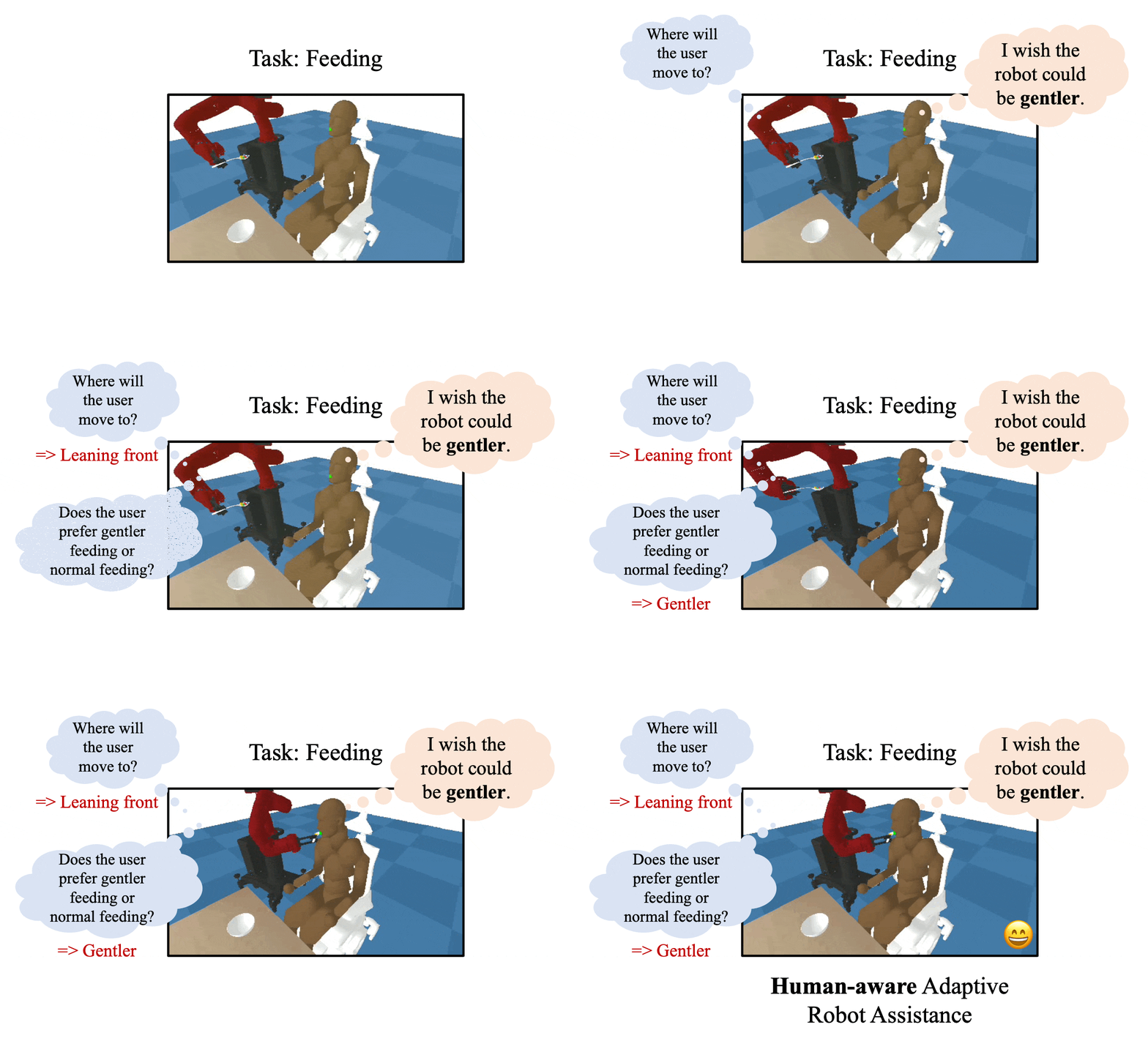 Learning Human-aware Robot Policies for Adaptive AssistanceJason Qin, Shikun Ban, Wentao Zhu, Yizhou Wang, and Dimitris SamarasIn IEEE Robotics and Automation Letters (RA-L), 2025
Developing robots that can assist humans efficiently, safely, and adaptively is crucial for real-world applications such as healthcare. While previous work often assumes a centralized system for co-optimizing human-robot interactions, we argue that real-world scenarios are much more complicated, as humans have individual preferences regarding how tasks are performed. Robots typically lack direct access to these implicit preferences. However, to provide effective assistance, robots must still be able to recognize and adapt to the individual needs and preferences of different users. To address these challenges, we propose a novel framework in which robots infer human intentions and reason about human utilities through interaction. Our approach features two critical modules: the anticipation module is a motion predictor that captures the spatial-temporal relationship between the robot agent and user agent, which contributes to predicting human behavior; the utility module infers the underlying human utility functions through progressive task demonstration sampling. Extensive experiments across various robot types and assistive tasks demonstrate that the proposed framework not only enhances task success and efficiency but also significantly improves user satisfaction, paving the way for more personalized and adaptive assistive robotic systems.
-
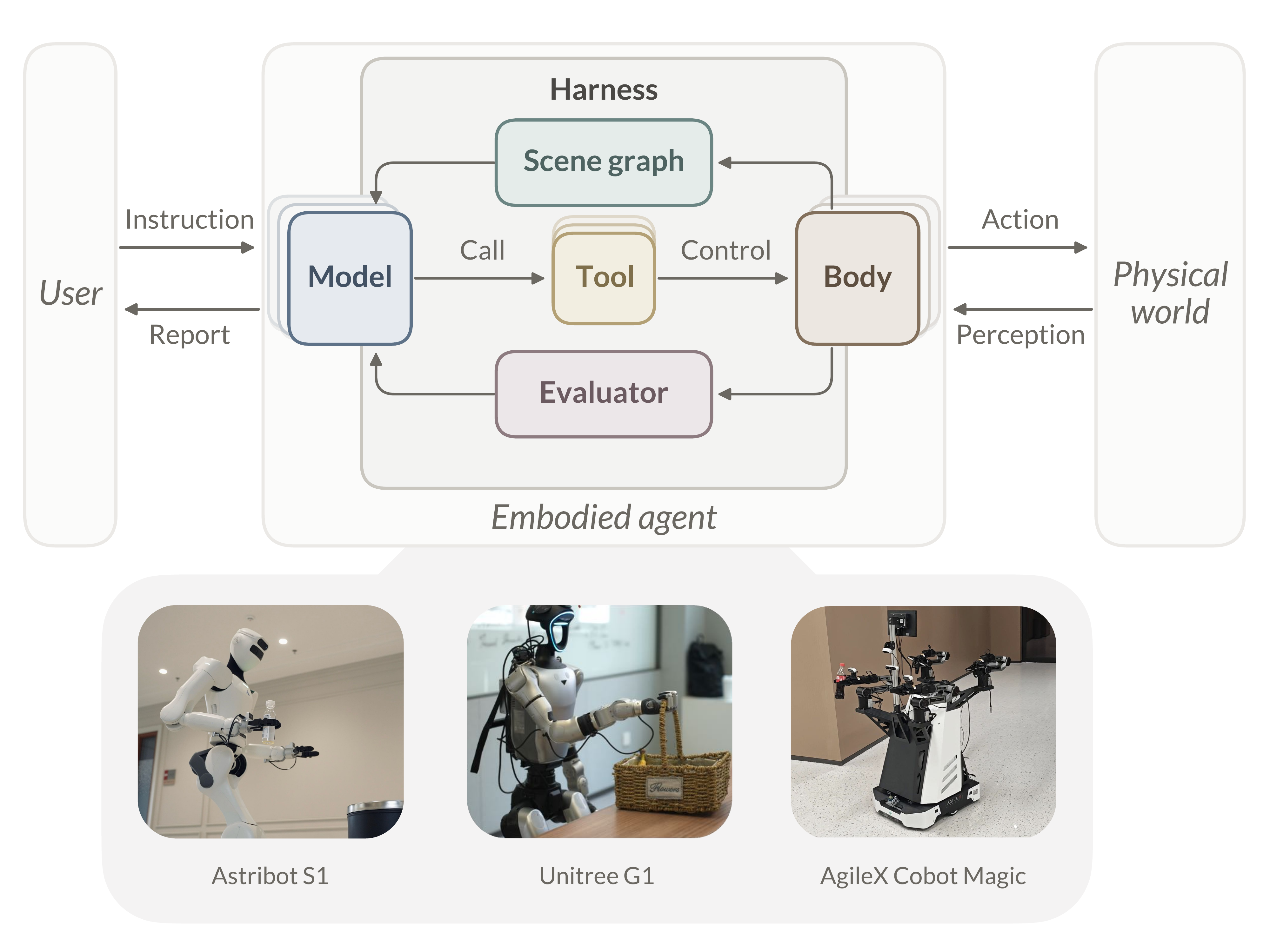 Towards the Harness of Embodied AgentsQi Wang† , Tianyi Wang†, Chengyang Li†, Shikun Ban, Yurun Chen, Yizhong Ge, Jason Qin, Chengtai Li†, and Wentao Zhu†Technical Report, 2026
The success of coding agents has established the harness as a paradigm: what an agent achieves depends not on the model alone, but on the infrastructure around it. We ask whether the same paradigm extends to embodied agents in the physical world. We present Thea, a harness in which an agentic loop orchestrates robot capabilities, each wrapped as a callable tool. It inherits the core components of coding agents, modified as the physical world requires. The world, however, withholds two abilities that software grants for free: reading the state of the world, and judging the outcome of an action. To bridge these gaps, Thea introduces Scene Graph as Context, a persistent, symbolic representation of the world, and Evaluation as Exit Codes, which detects when an action should terminate, judges whether it succeeded, and on failure diagnoses the cause. Together they close the loop between the agent and the physical world. Rich behaviors then emerge from the composition of tools, and the closed loop carries long-horizon tasks to completion in real environments.
-
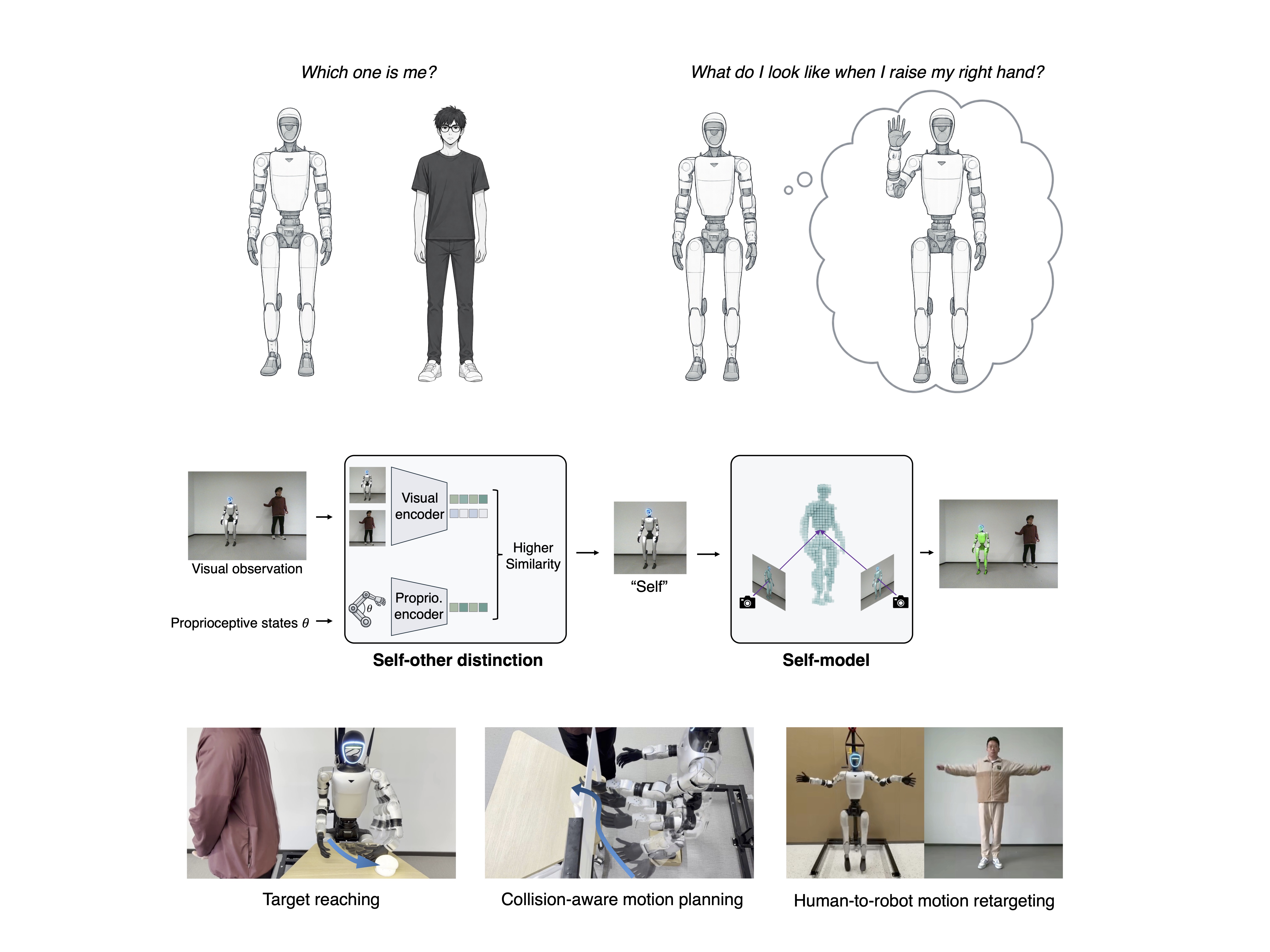 Proprioceptive-visual correspondence enables self-other distinction in humanoid robotsYurun Chen, Tianyuan Gao, Yizhong Ge, Shikun Ban, Yizhou Wang, Hongkai Xiong, Wenjun Zeng, and Wentao ZhuarXiv preprint, 2026
Distinguishing self from others is a prerequisite for social intelligence, yet humanoid robots that increasingly share workspaces with humans still lack this ability. Here we show that a humanoid robot can learn self-other distinction from proprioceptive-visual correspondence, without any identity labels or kinematic models. Once established, this distinction bootstraps a predictive self-model that maps joint configurations to three-dimensional body occupancy, capturing how the robot’s body changes with action. In multi-agent scenes involving humans or morphologically identical robots, the system reliably identifies itself, learns a 3D self-model, and supports downstream tasks including target reaching, collision-aware motion planning, and human-to-robot motion retargeting. Together, these results outline a route toward bodily self-representation in robots that act and coordinate alongside others in shared physical environments.